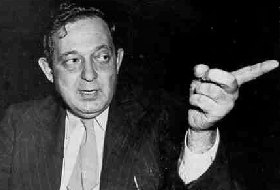
Benjamin Gitlow was convicted for publishing anarchist publications which called for "mass industrial revolts" which would develop into "mass political strikes and revolutionary mass action for the annihilation of the parliamentary state." The case was brought to the Supreme Court under the issue of whether the First Amendment protected these publications. The court ruled 7 to 2 to uphold his conviction because speech that presents "clear and present danger" is unlawful.
I feel the court made the right decision because a government should not solely protect the rights of an individual without regard to the well-being of the whole population. It is against the law to yell "FIRE" in a crowded movie theater because it would cause panic and possible harm. It is for this same reason that anarchist publications should not be protected under the First Amendment.
For years after Plessy v. Ferguson, African Americans fought for to end segregation. In a unanimous ruling to overturn the decision of Plessy v. Ferguson, the Supreme Court Ruled that "separate but equal" facilities in fact violated the equal protection clause of the 14th Amendment.
This is perhaps the most monumental court case in history. Denying access to certain facilities based on race clearly constitutes inequality. The fact that the Plessy v. Ferguson decision stood for so long is disappointing. I completely agree with the decision that separate cannot be equal and that segregation is unconstitutional. The court was correct in concluding that "in the field of public education the doctrine of 'separate but equal' has no place" because "separate educational facilities are inherently unequal."
After Clarence Gideon was arrested for breaking into a Florida pool hall he was denied his request for a court-appointed attorney. At that point the general consensus was that the 14th Amendment did not require the application of the Sixth Amendment's guarantee of counsel in criminal cases to state trials. However, the Supreme Court ruled in Gideon's favor, creating the law that the court must appoint an attorney if the defendant so chooses.
I completely agree with the court on this decision. If a person is too poor to afford a lawyer, he is incredibly disadvantaged in a trial and will likely lose even if he is innocent. The Sixth Amendment guarantees the right to a fair and speedy trial. A trial cannot truly be fair if the accused cannot afford to be represented in court. As Justice Hugo Black wrote, even an innocent person with a strong defense "lacks both skill and knowledge adequately to prepare his defense, even though he may have a perfect one. He requires the guiding hand of counsel at every step in the proceedings against him.
After Ernesto Miranda was arrested and interrogated, he took his case to court because he was informed neither of his right to an attorney or his right to remain silent. He argued that because the 5th Amendment states "no person...shall be compelled in any criminal case to be a witness against himself", his rights were violated. The Supreme Court agreed and ruled 5 to 4 to overturn his conviction.
Although the court made the right decision in passing what are now known as the Miranda Rights, I don't think that Miranda should have been set free after he was found guilty. In any case, it is true that police interrogation methods can be unjust so it is good that these rights must be told to suspects before questioning.
The Medical School of UC Davis used an admission system to accept or decline certain people based on minority status. When a white student was denied although his test scores were above those of the minority students, he sued the University saying that their process violated the 14th Amendment. The Supreme Court ruled 5 to 4 in two separate votes and majorities in favor of Bakke.
I agree with the court's decision that a program that accepts students based on race violates the equal protection clause. The court also stated that a properly devised program could be well constitutional but I have mixed feelings on this. I think that admissions processes should leave race out of the equation entirely and only accept students based on their qualifications. This way, every student has an equal chance based on their application alone.
After Miller was arrested for sending out unrequested mailings with obscene images, he stated that his First Amendment was being violated. In a 5 to 4 ruling, the Supreme Court voted against Miller stating that the First Amendment does not protect materials that are considered obscene.
I agree with the court's decision that obscene images are not protected under the First Amendment. Any citizen should not be subject to obscene materials that they do not want to view. The Supreme Court made the right decision in allowing local powers to choose what it obscene or not. As Chief Justice Warren Burger wrote, "It is neither realistic nor constitutionally sound to read the First Amendment as requiring that the people of Maine or Mississippi accept public depiction of conduct found tolerable in Las Vegas or New York City."
After Homer Plessy (who was one eighth black) sat in a whites only railroad car, he was arrested for breaking Louisiana state law. Although Plessy argued that this violated the 13th and 14th amendments which prohibits states from denying "to any person within its jurisdiction the equal protection of the laws." However, the courts ruled 7 to 2 against plessy concluding that as long as both races have "separate but equal" facilities, no laws are broken.
Today it is almost impossible for anybody to argue that the Supreme Court made the wrong decision. Even during the time period, the separate facilities were definitely not equal. In my opinion, it is impossible to consider someone an equal if they are restricted to separate facilities. Therefore, it is impossible to have separate and equal; for something to truly be equal, it must be accepted fully.